
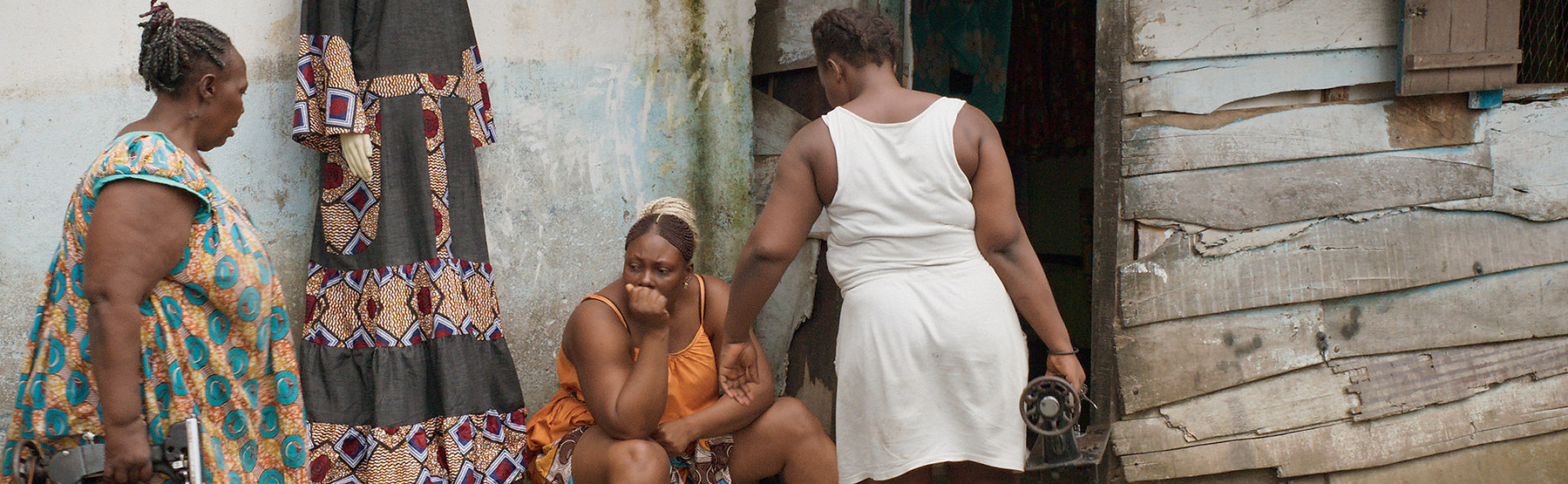
Still from Mambar Pierrette (2023).
Mambar Pierrette: A collective story of struggle and resilience
By IOANA BELU
Rosine Mbakam’s Mambar Pierrette follows the story of a Cameroonian woman who struggles to make ends meet. What dramatizes this particular story is the way Pierrette works so hard to earn money, yet external factors always bring her down. Pierrette’s labor becomes a dual lens through which we can understand both her and the world in which she operates, thus making her atelier central to Mbakam’s story. On one hand, the atelier represents Pierrette’s source of income. On the other hand, the atelier is the main space where the action happens, so it also becomes essential to understanding Cameroon’s social landscape. Clients and friends constantly come over to the shop, and it is in this space that the characters share moments of laughter, struggle, and personal stories. The film thus becomes an intersection between an intimate personal story and a broader political issue. This is evident through the presence of the white mannequin at the atelier (clear critique to colonial past), through the general themes of struggle and poverty, through the monologue between the clown and the mannequin, through the state’s lack of help when Pierrette reports her partner to the police, through the motorcyclists' theft, as well as through the characters’ personal stories. Most of these situations either happen physically at the atelier or are closely related to it. The movie does an excellent job at tracing Cameroon’s political landscape back to colonialism; however, watching it made me wish Mbakam also explored how current governments, while shaped by historical colonialism, are inefficient and accentuate citizens’ economic hardship. Undoubtedly, Mambar Pierrette's story is part of a larger complex issue, and her work in the atelier is central to how the film explores human relationships, solidarity, and survival.
Pierrette’s workplace is not just a sewing atelier; it is a space where clients and friends pass by to share conversations (often time about hardship), moments of laughter, and sadness. For example, a memorable scene happens when the character who is a clown/entertainer (Calvin Zognou) passes by the atelier and shares his struggles. The monologue between him and the white mannequin is very emotional and effective, a testament to resilience. In that scene, Mbakam subverted my expectations: when the clown started talking, I was convinced he would voice the frustrations of all Cameroonians against colonialism. Yet his speech was deeply individualistic and almost vague. I liked how Mbakam did not voice what the audience already caught on to during the movie (that the long-lasting effects of colonialism still affect people’s lives) and instead let the audience sit with this realization without overly explaining the symbolism. Additionally, Mbakam’s camera style observes people’s conversations and interactions in the atelier without intruding on the characters. The camera creates an intimate setting in which the audience feels part of Pierrette’s world.
What really stands out to me is that Mbakam does not portray Pierrette as a victim of her own circumstances. Instead, she is strong and independent. She handles everything that life throws at her without complaining. There is something so realistic behind her reactions and emotions because she is never trying to dramatize her experience. On the contrary, when faced with challenges, Pierrette never makes the audience (intentionally) feel sorry for her. Mbakam’s directorial style does not try to evoke those sentiments in her audience either. A key moment that illustrates that is when the thieves steal Pierrette’s hard-earned savings. Before and after that moment, most of the scenes are filmed through close-ups that help the audience connect with and feel Pierrette’s experiences. However, when her money is stolen, we only see the events happening from afar. Given that this is the only wide shot in the movie, I initially thought that through this directorial choice, Mbakam was trying to protect the audience from the violence of the act. I only later understood that this choice was meant to protect Pierrette, and to let her have this moment for herself, thus giving her intimacy in a film where so much of her life is already shared with others. By zooming out, Mbakam does not turn Pierrette’s suffering into a spectacle. The audience is not allowed to intrude on her pain or witness it up close. This moment belongs to Pierrette; it is not for the viewers to consume. That particular scene was so interesting because it contrasts with the way the workshop is filmed. At the sewing atelier, the audience witnesses many intimate moments between Pierrette and her clients, both through prolonged shots and close-ups. This contrast in Mbakam’s directorial choices emphasizes the central role of the workshop in the film, where most of the action happens. When Pierrette is in the atelier, the audience is invited in, and it watches in detail what a day in the workshop means for Pierrette, from her interactions with the clients to how she works with the textile materials. This solidifies the idea that the workshop is central to the film’s unfolding because it is central to Pierrette’s survival.

Still from Mambar Pierrette (2023).
As mentioned earlier, the white mannequin is fundamental to the film. More importantly, it is physically located in Pierrette’s atelier. While all the other elements in the atelier give the impression that they belong to the space, the white mannequin feels out of place. The latter constantly stares at its surroundings, making both the audience and the atelier’s guests feel uncomfortable. This is evident through the way the visitors react to the mannequin’s presence: some confess that they are scared of it; others ask Pierrette why she doesn’t throw it out; and others directly engage in a critical dialogue with it. Pierrette, on the other hand, could not be less disturbed by the mannequin. She seems amused by all these reactions. I think this is powerful because it suggests that Pierrette is too focused on her own sewing craft and financial problems to waste time on aesthetic details regarding her shop. The historical reasons that might explain her current suffering are less important to her; she is focused on making ends meet and being able to financially support her family. Pierrette does not try to justify her current financial situation. Yet symbolically, the mannequin is a reminder that Pierrette’s struggles are not individualistic but rather part of a larger political problem. However, in the present day, the story is more complex. Current government’s corruption and inefficient decision-making are part of the reason people like Pierrette can’t escape their current financial burdens and are stuck in their struggles. It is true that colonial history explains most of the situation; however, it is not the full story. Thus, I would have liked to see the film addressing the other side of the story too, because a well-rounded approach would have added depth to the film’s critique.
Mambar Pierrette is a film that explores labor, community, and resilience, showing the everyday struggles of people living in a postcolonial country. To illustrate this, Mbakam uses simple camera work that carefully captures the dialogues and interactions between characters, following a few days in Pierrette’s life as she makes ends meet. Pierrette’s struggles are not unique; they are part of a collective story of struggle. Female labor, mostly seen at the atelier, but also present in Pierrette’s home – as she takes care of her kids and her mom with no exterior help – thus becomes a tool to understanding survival. To this end, Mbakam tells Pierrette’s story in a way that dignifies her experience. Ultimately, the film is an invitation to think more about our history and demand change.