
Conversation with Sky Hopinka
By Doak Dean
Małni — towards the ocean, towards the shore: An Authentic Perspective of an Indigenous Nation from Sky Hopinka
By Doak Dean
Małni — towards the ocean, towards the shore: An Authentic Perspective of an Indigenous Nation from Sky Hopinka
By Doak Dean

Still from We hold where study (2017).
Conversation with Wu Tsang
Led by JULIAN LI
Wu Tsang’s fluid work spans moving image, performance, and theater, though she hopes, above all, to be known as “someone who collaborates.” She first gained recognition with her documentary Wildness (2012)[1] and is known for her deeply collaborative practice. Working with the transdisciplinary ensemble Moved by the Motion,[4] she creates films and performances that evolve through shared authorship while exploring themes of visibility, collectivity, and alternative storytelling. She is currently based in Zurich as an in-house director at the Schauspielhaus Zurich.
The following is an excerpt from a presentation and discussion during Tsang’s class visit on February 6, 2025.
She begins by discussing the creative process and the inspirations behind some of her most well-known works.
WU TSANG: With We hold where study (2017),[2] I was caught up in questions about representation. It was a kind of hangover from making Wildness, a documentary about a club in LA that I used to do with my friends. It gets into the discourse around what a safe space means for queer, trans, and undocumented people in nightlife. I tried to make a film about it and address the problems of telling that story in a linear narrative… I don't know if the film succeeded, but I think it raised the issues in an ethical way, but also in a way that was problematizing storytelling. I felt satisfied but also conflicted. The film went out into more mainstream circulation — it went to festivals, won some awards, had meetings with sales agents, and became a springboard for feature filmmaking. But somewhere along the way, it started feeling really icky. I felt like there was a cost to who I had to be as a trans filmmaker and the kinds of stories I would have to tell. Thankfully, now I feel like that’s not the case, but in 2012, I encountered a lot of really crazy attitudes in the film industry and realized I didn’t have the appetite for it.
I decided video and performance art might be spaces where I felt more energized to explore representation. With We hold where study, we had this idea of the unavailable image — an image uncapturable, like social entanglement. Then there’s the image we do see, which is captured and, in some sense, a lie — a hyper-visible image coated with all the ways we look at cinema. Both are fictions: One is unavailable, the other a lie. That was the idea behind the two projections.
I got obsessed with using camera choreography to sew two realities together, inspired by Charles Atlas, who mentored me at the time. He was a very inspirational person to me. Charlie did dance collaborations with Merce Cunningham. Merce often choreographed dances based on the camera movements Charlie designed. That blew my mind. That’s why those dance films feel so different — the camera is really in the performance. It made so much sense that Merce liked that kind of chance limitation parameter, where the filmmaking was already embedded in the dance.
We hold where study was my ode to that epiphany and a conversation with Fred [Moten] about exploring these ideas through contact improv. Growing out of We Hold Where Study was this text that became heavily annotated and turned into a script for another performance. That iterative process — like an exquisite corpse — defines Moved by the Motion: Ideas turn into films, films generate new ideas, which become performances, and then performances inform new films. It evolves slowly.
We had a text Fred wrote, which we turned into a score for music, then into a stained glass piece with text from All That Beauty, which explores metaphors of spiraling camera movement. It’s about finding mediums for different iterations — sometimes in response to circumstance, sometimes because of an urge to figure something out. One metaphor from We hold where study was the idea of art as something you see through — what if art is just a window? There’s a semi-capture but also an escape through that window. So I thought, I have to make a window.
This was when I moved to Zurich and had a bit more resources, working in a theater where they could build sets and costumes. We could explore ideas at a larger scale, introducing theater elements with actors and texts — learning how to tell stories in that format, which was new for me.
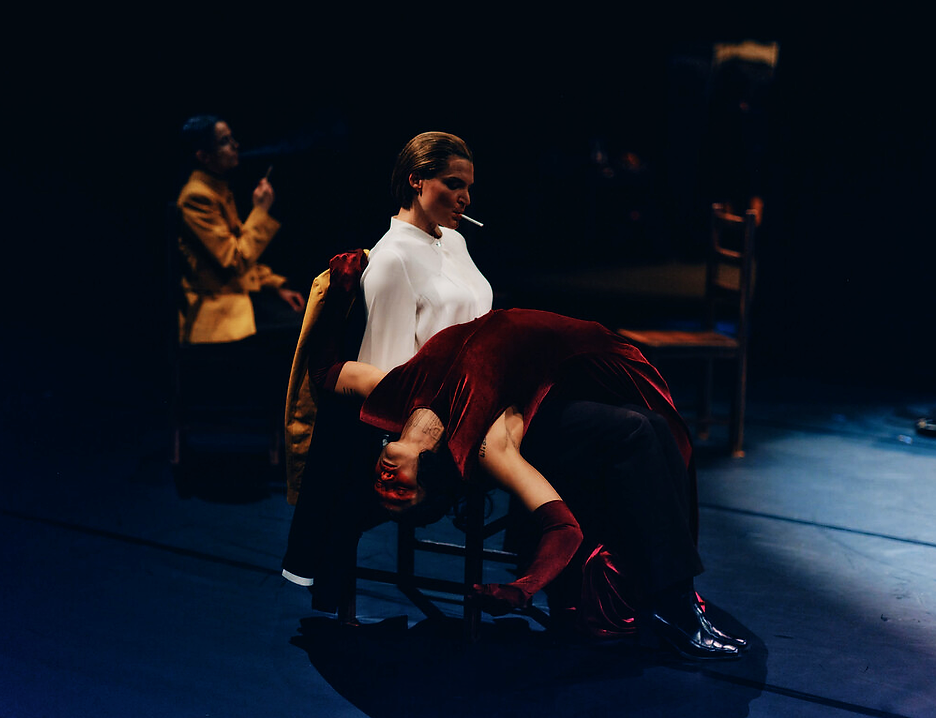
Wu Tsang and Moved by the Motion's Carmen (2024).
AILY NASH: What was it like coming together with the preexisting actors and theater crew that merged with your own collaborative group, which already had a long history and developed language?
TSANG: It wasn’t an easy adjustment. I remember the first day of rehearsal, 20 people were just standing there staring at us, and we thought: We can’t work with all these people watching. This is crazy. But you get used to it.
I came to appreciate the structure of theater, where there’s much more emphasis on collaboration and the acknowledgment that many people are needed to make things work. There’s a focus on process and keeping everyone up to date — not just the actors but also the technicians and workshop staff. For example, before a production, the first thing we do is meet with the entire house — about 300 people — to present our concept. I love that.
Coming from visual art and exhibition-making, it amazes me that there’s not those moments where the institution considers themselves a house like that. When artists install shows, there should be a day when they share their work with installers. Instead, there’s a hierarchy where artists only talk to curators, who then instruct everyone else. Theater is also hierarchical — I’m a director, so people look to me like: Okay you’re the one that’s going to decide things. But within our group, we work non-hierarchically. We had to figure out how to protect our thing internally while making it communicable to the house. It wasn’t easy, but now we’re on our ninth production there.
I really enjoy the process. Coming from filmmaking, I never thought about how, as a filmmaker, you're trying to make an emotional truth for the camera’s frame. In narrative filmmaking everything outside the frame is fake — someone’s holding something, ready to throw it, or standing off-screen, constructing the scene. As long as you get the shot, that’s the work.
Theater is different. You have to create relationships and truth in real time, over and over again. You might get it once in rehearsal, you have to do it again and again, always slightly differently, with a different audience each time. There’s never a moment where you think: Okay, we got it. It always escapes in a new way. It’s much more exhausting. Maybe I’m getting more comfortable with it… I’ve gained a lot of respect for the craft. In film, you only need one good take — you can throw away the rest or fix things in editing. With live performance, you don’t have that luxury.
JULIAN LI: In works like We hold where study, Girl Talk (2015),[3] and others we’ve read about, the body is really centered. In a previous interview, you mentioned how the camera can tell one story while the body’s movement tells another. What does the physicality of movement and dance mean to you in your work?
TSANG: It’s interesting — I’m not a dancer, but when we’re working on performance projects, I’m always very involved in the physical creation. I feel like I need to be doing what everyone else is doing, so in some sense, embodiment is important to me as an artist — not just being behind the camera but physically experimenting with people.
I do find that people who have a special way with movement language are really inspiring to me. Maybe because, as I explored in Wildness, nonverbal communication offers possibilities beyond words — words always feel inadequate to express. Working with people who have an evolved sense of bodily communication resonates with me deeply, even if I can’t express myself the same way. I guess my way of contributing is finding ways to translate that into cinema — to transform what I experience in performance into a cinematic language.
TEGA AJISE: In your essay[5] on Wildness for the Whitney Biennale, you talked about realizing, in the process of making Wildness, that you had a fantasy of queer liberation based on documentation of past civil rights movements, but the material truths that emerged didn’t necessarily fit the idea of a cohesive resistance movement. You also mentioned that who you were at the beginning of filming wasn’t who you were by the end. Were there other ways your perspective changed — things you reconsidered or saw differently by the end of the process?
TSANG: Yeah, thanks for sharing that quote — what you said reminds me of a big revelation I had.
I had this idea of civil rights movements of the '60s and '70s shaped by film and archival imagery. In my mind, they looked so romantic and powerful — everyone was inspired, speaking with conviction. But looking at the present, I thought: It’s so chaotic — what are we doing? Then I realized film has the power to organize things.
One of my naïve beliefs was that a film’s mission was to put everything together, make it coherent, and share it with the world — that it could actually change the world. I don’t think that’s a bad thing to believe, and I don’t even fully disagree with it now, but I have much more humility about it.
I think the chaos and incoherence of the present moment — the reality of movements — is actually what’s beautiful. A film doesn’t have to make things coherent. That’s why I feel more comfortable working in an experimental genre — I don’t like the pressure of film as a format requiring coherence. Even if that means not everyone will see the work, it will still find its way through other means.
XINRAN LI: In the Whitney essay[5] you mentioned feeling privileged because of your educational background but also marginalized as a trans person of color. After years of making art, how do you make sense of privilege and power? How do you work toward justice? And how do you describe your way of making art?
TSANG: I think these questions are at the heart of everything I consider when I’m asked to do something.
The essay I wrote about Wildness was in 2012, and identity politics discourse has shifted a lot since then — thankfully. But one of the things I found myself retreating from after Wildness was how trans visibility suddenly became very mainstream. I remember the year Laverne Cox was on the cover of Time with the headline “The Transgender Tipping Point.” I remember thinking, What is this? This doesn’t feel like it’s going well. Of course, now we have thoughtful reflections from community activists but this dynamic has played out across all marginalized communities.
Hypervisibility is such a trap. The visibility of trans people, or of minorities in mainstream cinema, the military, or government — these modes of recognition, within authoritative systems like culture or government or healthcare or education — have often brought violent repercussions. And now, many of those supposed gains are being taken away.
But the truth is, we’ve always had to improvise. We’ve always had to take alternative routes to get what we need and survive. That often means being undercover, resisting through invisibility, or refusing to be recognized in the ways they want to recognize us. It’s a scary moment, and there are real losses, but it’s also a reminder of the strategies that have always mattered most: We need each other to survive. The idea that things would be fixed at a systemic level was always a myth.
AJISE: I was thinking about Wildness, Tuesday nights at the Silver Platter, and how that whole story unfolded. I wonder if you think there’s a link or connection to make between the average lifespan of trans people and the lifespan of trans communities, safe spaces, or movements?
TSANG: I think the film tries to explore how those concerns are real but also complex. Being part of a community means surrendering the idea that any one person is responsible for maintaining it. There has to be a shared contract, or commitment — we show up, knowing it might be taken away someday.
No one is the gatekeeper of who can be there, and when displacement happens — as it eventually does — we have to understand that the scene lives on in other forms. That surrender is powerful.
I didn’t have answers — I just wanted to show some of the struggles between people with different opinions. But I also think that struggle is what makes community beautiful. That’s why I find the term “safe space” ironic. The Silver Platter wasn’t a safe place — it was a dramatic place. People fought, there was hidden drama, shit-talking — but that’s community. People showed up and gave life to each other. It wasn’t about always being happy or comfortable, but about feeling like, This is mine, and I’m showing up here.
That’s what I hoped to communicate through the film.
JIM SOLOMON: If you could communicate with your 21-year-old artistic self from this vantage point, what do you wish you had known? What would you say to artists at that age, from where you are now?
TSANG: It’s funny— being here this week, I’ve actually been communing with my 16-year-old self. I’m from Worcester, Massachusetts, and when I was a teenager, I used to take the train every weekend to Harvard Square and hang out in the Pit because, to me, that was the coolest place where the coolest people were. I was searching for something beyond my suburban Worcester life. That’s where I found queer people, punks, people doing riot grrrl music—things that felt countercultural at the time.
It’s cute walking through the square now, it feels so small. In my memory, it was huge, with all these different groups and cliques. I would go every weekend — arriving Friday night, finding random places to sleep, and going home Monday morning. It was a real discovery.
I think that moment of youth, of seeking your community, of finding like-minded people resisting the mainstream, has fed me at every stage of my career. It has always been my motivation for making work, and ultimately, it’s what people have responded to. If I get validation for my work, it’s because I’ve focused on that, and I think that transmits. The way we find community has changed — now it happens more online. You don’t necessarily have to go to a physical place to find it. But that feeling of connection, of finding your people, is universal.
XINRAN LI: When you start a project, you have a general idea of what you want to make, then go through this long process to bring it to life. What’s the most joyful moment for you in that process? And does that joy stay with you?
TSANG: …I really love editing.
I don’t consider myself a scriptwriter, but I love editing. I work with editors, but it’s the part of the process that feels most like a craft to me. It reminds me of painting or a studio practice — where you get to work intuitively, using your body, without overthinking.
Even though editing is very technical, it feels like a deeply creative space, especially when you discover things.
BRENNIS CARRILLO: As we write about your work — since you’ve done so many things in different mediums and industries — how do you want to be perceived as an artist? What do you want people to take away?
TSANG: How do I want to be perceived? I don’t know.
I guess… if people know me as someone who collaborates, that would be my favorite thing. But I don’t say that lightly — there’s an inherent contradiction. Saying I’m known for collaborating means I’m known — there’s tension there, because I have to perform this solo artist persona, but in reality, I only exist in relation to all these other amazing people.
If I can continue to push the space to challenge the way and vocabulary for talking about artistic work, it’s that people should be understood as not solos, or individuals, as much as we can be, as much as there is a need to consolidate. That’s always temporary for me.
REFERENCES
[1] Tsang, Wu, dir. Wildness (2012).
[2] Tsang, Wu, dir. We hold where study (2017).
[3] Tsang, Wu, dir. Girl Talk (2015).
[4] Tsang, Wu. “Moved by the Motion: A Pentalogy,” 154-174.
[5] Tsang, Wu (2012). “Wu Tsang on Wildness for the Whitney Biennale,” 287-289.