
Małni — towards the ocean, towards the shore: An Authentic Perspective of an Indigenous Nation from Sky Hopinka
By Doak Dean
Małni — towards the ocean, towards the shore: An Authentic Perspective of an Indigenous Nation from Sky Hopinka
By Doak Dean
Małni — towards the ocean, towards the shore: An Authentic Perspective of an Indigenous Nation from Sky Hopinka
By Doak Dean
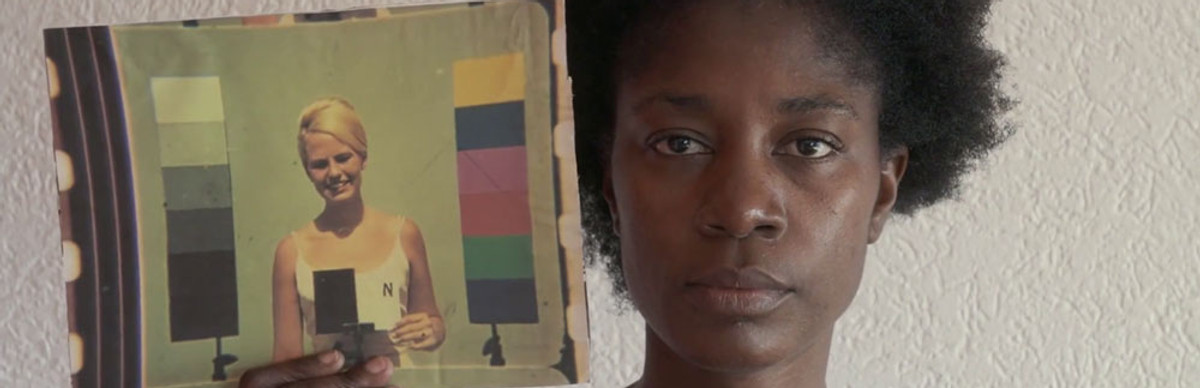
Still from PRISM (2021).
Conversation with Rosine Mbakam
Led by BRENNIS CARRILLO
Rosine Mbakam is a Cameroonian film director based in Belgium. She is known for her nonfiction work representing and advocating for her community in Cameroon, and her internationally-prized documentary film Les deux visages d'une femme Bamiléké / The Two Faces of a Bamiléké Woman (2016), in which she centers her family as the subjects after returning to her mother’s home in Cameroon after seven years spent abroad in Belgium. Mbakam made her feature film debut with Mambar Pierrette (2023) and continues to emphasize the importance of sharing untold stories and breaking the Western norms of mainstream media.
The following is an excerpt from a presentation and discussion during Mbakam’s class visit on February 13.
BRENNIS CARRILLO: Chrystel Oloukoï described your craft as taking “on the mantle of documenting without the arrogance of documentation.”[4] What inspired you to practice nonfiction filmmaking, and how did you find your style?
ROSINE MBAKAM: I initially resisted nonfiction because it was unfamiliar to me. Growing up in Cameroon, I only watched fiction—documentary films simply weren’t accessible. It wasn’t until I attended film school that I encountered documentary filmmaking for the first time.
Through documentaries, I came to understand the power of this medium—both its ability to reveal truth and its potential to distort it. I saw how documentaries had been used to manipulate the identities of marginalized communities like mine. This realization forced me to confront the extent of my own colonization—the ways I had absorbed narratives without questioning them. When I saw how my community was portrayed in documentaries, I began to interrogate history itself. I recognized how documentaries had been wielded as ideological tools—subtly reinforcing dominance and erasing certain perspectives.
Film school exposed me to a deeper truth: what I had been taught as “my story” was not my story, and what I had believed to be my identity was something imposed on me. I needed to deconstruct and decolonize my gaze, my identity, and my artistic tools. I had to redefine cinema on my own terms.
Documentary filmmaking, with its intimacy and direct engagement with reality, became a way for me to dismantle colonial frameworks. It also helped me envision the kind of fiction I wanted to create—fiction that does not perpetuate control and power in the ways I had seen before. I was learning a form of fiction that had been historically used against people like me, and I refused to replicate that. Documentary filmmaking became my guide in finding a way to tell fictional stories that respect both who I am and the people I choose to film.

Still from PRISM (2021).
JULIAN LI: I was thinking of PRISM (2021) because I've never seen a film bring segments from different filmmakers together. I was thinking of all the differences you had. An was a white filmmaker with a very different background. With Eleanor, you disagreed about where blame for the bias on the camera should be. And of course you all have your very individual styles. Could just share what that collaboration was like and how did that affect the work you produced for PRISM?
MBAKAM: Thank you for asking that question; it was difficult. The process of filming PRISM was very hard, and it made me question the very nature of the collaboration. I think that true collaboration can only exist when people are given the full freedom to be themselves. It is impossible if equality is not genuinely present.
An brought this project to me because it stemmed from her research. She had the funding, the concept, and a vision for how it should be executed—using a style that was unfamiliar to me. I remember thinking, You want to collaborate, but you bring the money, the idea, and the structure—so what do you need from me? Will you also dictate what I have to say?
Making the film was exhausting because I constantly had to deconstruct and push back. Even now, when I watch PRISM, I feel frustrated. I didn’t have the time or space to fully express what I wanted. I wanted to build a space of true collaboration—one where I wouldn’t have to simply “let things go” (laisser passer les choses). I didn’t want to fight to be heard, but I also refused to remain silent. This struggle came from my own history of domination, and I was determined not to lose something again. It was a battle. The initial edit merged our images and essays, but you cannot simply juxtapose our perspectives as if they exist on equal footing. Our histories, our legacies—they are not the same. If we are addressing this topic, I need my voice to be heard because my experience is different.
What I learned through this process is that real collaboration is incredibly difficult. It’s not impossible, but for it to be genuine, the subject matter must emerge organically between collaborators.
This collaboration with An revealed an invisible legacy that we rarely question. It was fascinating to watch how these legacies unconsciously shape us. An is my friend, and I truly appreciate her. She approached this project with good intentions, but she hadn’t fully realized the biases she had until the filmmaking process exposed them. In that sense, the experience was powerful.

Still from Mambar Pierrette (2023).
AILY NASH: In the end, through the discussions, did she come to terms with the things she didn't realize?
MBAKAM: Yeah. She was really sad; it was a confronting moment for her. This project is a work that I didn’t finish completely, because I like to write about all my experiences. However, I broke that with PRISM. Even now, three or four years after making this film, I'm not at peace with it, not yet. And when I finally will… that remains uncertain.
ELIOT FELDE: Are you interested in pursuing a collaborative project after this?
MBAKAM: Not for now. A film isn’t just something to make; it’s a process of transformation. Collaboration then becomes a question: are you willing to be transformed? Every time I make a film, I have to maintain integrity, allow myself to be changed, and remain accountable to the people whose stories I tell—because they are people, and filmmaking is a confrontation of our differences. If I am not transformed, then I am merely exerting power.
People often come with good intentions, wanting to collaborate, but they aren’t always prepared to shift their perspective or do the personal work that true collaboration requires. That’s what An did—she was willing to stop, to process, to question, and to admit when things needed to be reconsidered. And because of that, the process was constantly evolving.
ANDREI MITOIU: I was wondering about the difference between fiction and nonfiction in Mambar Pierrette. What were the challenges of shooting in Cameroon and how did it dictate how the film was made? Mambar Pierrette feels very real, and I’m curious how you were able to almost achieve a nonfiction film in a fiction piece.
MBAKAM: A challenge I constantly face as a filmmaker is how to navigate the power I hold—especially when working with my family, who are unfamiliar with cinema. Every time I pick up the camera, I ask myself: How do I use this power responsibly? How do I make sure that I am not using it against the very people I’m filming? Whenever I start a project, my friends and family become excited and eager to help, wanting to do everything for me. But my role is to create balance—to foster a space where they are not there to serve me, but are there as equals. A space where they can advocate for themselves and challenge my ideas if I am wrong.
For example, when making Mambar Pierrette, I built the story from pieces of Pierrette’s real life, but parts of the script came from my own imagination. My goal was to bring that imagination as close as possible to her reality—because, for me, filmmaking is not about simply making films, but about telling people’s stories. And by telling people’s stories, we are creating our own collective narrative. When our identities are still shaped by Western colonization, it becomes difficult to separate what is truly ours from what has been imposed upon us. That’s why it’s so important for people to tell their own stories.
As a filmmaker, I see my role as creating a space where that can happen. With Mambar Pierrette, I wanted to give people confidence—that we can break away from colonial narratives. In Cameroon, we often reference France in our way of thinking and living—not because we want to, but because it has become an unconscious reflex. I wanted to disrupt that reflex, to remind people that they can simply be themselves. That’s why I didn’t focus on mise-en-scène (the arrangement of a scene), but on mise en confiance (building confidence). The goal wasn’t just to direct a film, but to give people confidence. It started with choosing Pierrette’s story. I did not want to make it a purely fictional film where I inserted her and my family; instead, I wanted to honor their lived experiences. By doing so, I was telling them: Your story matters. You matter. And your life belongs in cinema. When I used to watch Western films, I often thought, There’s no place for my story in this kind of cinema. I imagine my family felt the same—that their stories could never belong on screen. But by choosing Pierrette’s story and filming in our own homes and neighborhoods, we gave significance to places that are often overlooked—even within Cameroon itself. That’s why mise en confiance was so central to my approach. More than just a filmmaking technique, it was a way to reaffirm the importance of our lives, our spaces, and our stories.

Photograph from the shooting of The Two Faces of a Bamiléké Woman (2018).
IOANA BELU: Could you talk more about your experience working with non-actors? I imagine that returning home to film your parents, relatives, and friends—especially those unfamiliar with being in front of a camera—can be challenging. It might create a sense of awkwardness or make people act differently than they normally would. How do you navigate those challenges and help them feel comfortable during the filming process?
MBAKAM: Working with my family is easier—it comes with an existing relationship. The first time I brought a camera in front of my mother, I was afraid she would gasp, "What is that?!" But I realized something profound—because it was me behind the camera, she didn’t really see the camera. She saw me. That changed everything. When I filmed my mother in The Two Faces of a Bamiléké Woman, I was struck by how natural she remained. That authenticity wasn’t because she was used to the camera—it was because she was used to me. That’s when I understood that my presence, my relationship with her, created a space where she felt safe enough to just be.
Working with non-actors, especially family, becomes an organic process. There are things in filmmaking that you can’t fully control—things that emerge naturally when you find your own line of questioning. As a filmmaker, I don’t approach a film thinking I can do everything I want. My questions shape my position, and once I find that position, it dictates my gaze, my choices, and the way I engage with my subjects. That’s when everything starts to flow naturally.
Of course, I faced challenges. When I first presented the script about my mother to a producer, he told me, "Your mother is not funny. She’s not a character for a film." It was a violent response—because my mother, my family, my experiences, are the very foundation of my cinema. At that moment, he was telling me that my story didn’t matter, that it wasn’t cinema. This interaction made me doubt myself for a long time. But deep inside, I knew this was what I wanted to do.
In Belgium, I don’t have much institutional support because the stories I tell, the perspectives I push forward, aren’t considered “important” within the industry. That’s part of the struggle—to hold onto what you know is important, even when the system around you tries to dictate what is worthy of being told. Coming from a colonized country, I know what it means to have choices taken away. My parents never had the chance to be who they truly wanted to be. But I do. And that, to me, is the most important thing—to claim my voice fully, without compromise.
It’s not always easy. Sometimes I work with very little money, with whatever resources I can find. Sometimes that means precarity. But despite all of that, it keeps me alive. Yeah.
REFERENCES
[1] Mbakam, Rosine, dir. Mambar Pierrette (2023).
[2] Mbakam, Rosine, dir. The Two Faces of a Bamiléké Woman (2018).
[3] Mbakam, Rosine, dir. Prism (2021).
[4] Oloukoï, Chrystel. “Experiments in Liberating the Frame: Rosine Mbakam’s Confessional Cinema,” Open City Documentary Film Festival.
[5] Dienderen, An van, et al. “Through Prisms Practice-based Research on the Intentions of Collaborative Filmmaking,” In Anthrovision, vol.7.2, 1-24. (2019)