

Still from Saint Omer (2022).
Alice Diop: Cinematic Language Breaks Barriers of Silence and Oppression
By ANDREI MITOIU
The “Venus” figure, as theorized by Saidiya Hartman in "Venus in Two Acts,"[3] is the embodiment of countless enslaved Black women whose lives were erased from the archive. More specifically, Venus appears in historical records as the name of an enslaved girl who died on the slave-trading ship called “Recovery”. However, Hartman uses this name to represent several instances of oppressed and dehumanized Black women in Atlantic slave trade records. Furthermore, she recognizes that even outside of the examples mentioned, “there are hundreds of thousands of other girls who share her circumstances and these circumstances have generated few stories.” [3] Exploring similar themes regarding Black women’s oppression, Audre Lorde’s “The Transformation of Silence into Language and Action”[4] presents the importance of transforming centuries-long silence into language and action. “What is most important to [her] must be spoken, made verbal and shared, even at the risk of having it bruised or misunderstood… the speaking profits [her]”[4] and acts as a means of confronting fear and oppression. Alice Diop’s cinematic work aims to bring “Venus” stories of the untold to the eyes of moviegoers and break the veil of centuries-long quietness. Whether in her fiction film Saint Omer (2022)[1] or her documentary La Permanence (2016),[2] Diop ultimately compels action by breaking silence—using the language she knows best: cinema.
La Permanence, one of Diop’s earlier works, centers the stories of refugees in France—people the broader public rarely hears from. The film documents their struggles to access welfare after immigration, portraying real accounts of violence, poverty, and suicidal ideation through a raw, unfiltered cinematic language. As viewers, we join the doctor and the other personnel in the consultation room. They attempt to treat each patient with as much compassion as they can but are ultimately powerless to change a political system that leaves refugees in extreme precarity. The consultation room is small, old, and worn down; within its walls, the stories are heard, but barely. When patients leave the clinic, their stories leave with them, unheard by the outside world.
Diop seeks to change that. By documenting these stories through film, she expands the walls of the clinic into the space of the cinema. These stories, once confined to two overworked healthcare professionals, are now witnessed by a full audience. Through the editing choices of the film, we get to experience and feel the pain of people whose stories are almost always ignored. Diop actively chooses not to cut away from the faces and bodies of distressed patients during a consultation and makes the effort to give them all the time they need to express themselves. While Venus may have been forgotten–“no one remembered her name or recorded the things she said, or observed that she refused to say anything at all”[3]–Diop urges audiences not to anonymize or forget these stories despite language or cultural barriers. Even though the patients struggle to communicate with the doctors, they are eventually understood, given enough time within the clinical and cinematic space. The only time the film cuts away from the patients, almost exclusively, is when we observe the French doctor and his personnel. They are a direct reflection of the audience. Unlike the patients, we also have the privilege to own a voice not bound by language. “For [us], it is [necessary] to share and spread also those words that are meaningful to [them].”[4] Just as doctors try to heal their wounds, we must try to fix the systemic issues they face. While France recently adopted stringent immigration laws in January of this year, protests with more than 75,000 people in the streets prove that cinematic works like La Permanence are successful in turning oppressed silence into empowering action. Ultimately, in the film's final moments, the cinematography reveals a quiet and empty waiting area outside the consultation space, showing how these stories need to escape the clinic and be shown to the wider world. As the camera drifts away from the consultation room, the narratives must follow too.
Saint Omer, Diop’s only fiction film, is directly inspired by the real-life Fabienne Kabou trial, in which a Black Senegalese woman was convicted for drowning her infant daughter. In the film, the defendant becomes Laurence Coly, a Black woman who stands out for the eloquence of her speech. The main character is Rama, a literature professor and the fictionalized representation of Alice Diop. Rama acts as a vessel to express Alice’s feelings during the trial. While the film explores the insecurities and anxieties of motherhood, it also grapples with how the ghost of one's past is carried and reshaped through speech that breaks the silence.
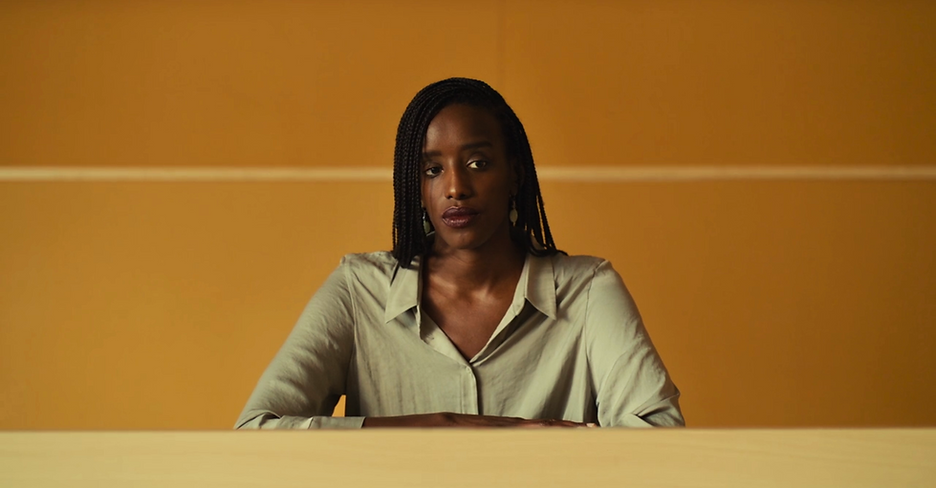
Still from Saint Omer (2022).
While the movie presents clear parallels between the trial and the mythological story of Medea, it also indirectly embodies and presents a version of the “Venus” entity. The similarity to Laurence’s story presents itself when looking at Hartman’s concept of the “Haint”[3]: a Black woman/girl who haunts the present. Alice Diop’s use of mise-en-scène choices plays a crucial role in establishing this similarity, as Mrs. Coli stands and speaks among the quiet crowd that sits. The lawyers, audience members, and court officials are all haunted by the ghost of Laurence’s child and by Laurence’s presence itself. She is the killer, yet the main carrier of her daughter’s story. The dichotomy between the two perspectives that engage with this story is most apparent when the two opposing lawyers stand up to talk to witnesses or state their conclusions. While one urges empathy for Mrs. Coli, the other condemns her as a monster. The ghost’s story takes the shape of the mouth that recalls it, resurrected each time someone rises to speak. This mise-en-scene and emotional dichotomy work together to embody a “Haint”[3]; despite the historical violence and erasure experienced by black women, their presence and the legacies of slavery continue to impact and linger in the present as well. “Silence will not protect you”[4], and as historical systems of oppression still impact perspectives of modern black women, it is only those who break the silence that are heard. Similar to the dynamic showcased in the film’s courtroom, stories are told and shaped only by those who break the silence, so much so that “the speaking profits [them], beyond any other effect”[4]. As in La Permanence, Alice ends with an image of emptiness. Yet here, the location seems suspended in time, still marked by the absence of those who once filled it. It is now that we realise how the film itself has become a Haint - a mausoleum for the little girl who died. This story, now told through cinematic language, will forever haunt and represent the contemporary.
Through both documentary and fiction, Alice Diop transforms cinema into an act of resistance—one that gives voice to the silenced, visibility to the erased, and urgency to the forgotten. Her films act as bridges between the archive and the present, between those who have historically been spoken over and the audiences who now bear witness. Drawing on the work of thinkers like Saidiya Hartman and Audre Lorde, Diop positions herself not just as a filmmaker, but as a translator of silence—translating pain, resilience, and complexity into a visual language that demands to be seen and heard. Whether in the intimate spaces of La Permanence or the haunting courtroom of Saint Omer, Diop refuses to let silence settle. She confronts the legacy of violence against Black women and compels her viewers to recognize the humanity in those who have long been marginalized. In doing so, Diop doesn’t just tell stories—she reclaims them. And with each frame, she insists: silence may be the past, but it cannot be the future.
REFERENCES
[1] Diop, Alice, dir. Saint Omer. (2022).
[2] Diop, Alice, dir. On Call - La Permanence (2016).
[3] Hartman, Saidiya. “Venus in Two Acts,” In Small Axe, No. 26, 1-14. Duke University Press, June 2008.
[4] Lorde, Audre. “The Transformation of Silence into Language and Action,” In Sister Outsider: Essays and Speeches, 40-44. New York: Crossing Press, 1977.