
Małni — towards the ocean, towards the shore: An Authentic Perspective of an Indigenous Nation from Sky Hopinka
By Doak Dean
Małni — towards the ocean, towards the shore: An Authentic Perspective of an Indigenous Nation from Sky Hopinka
By Doak Dean
Małni — towards the ocean, towards the shore: An Authentic Perspective of an Indigenous Nation from Sky Hopinka
By Doak Dean
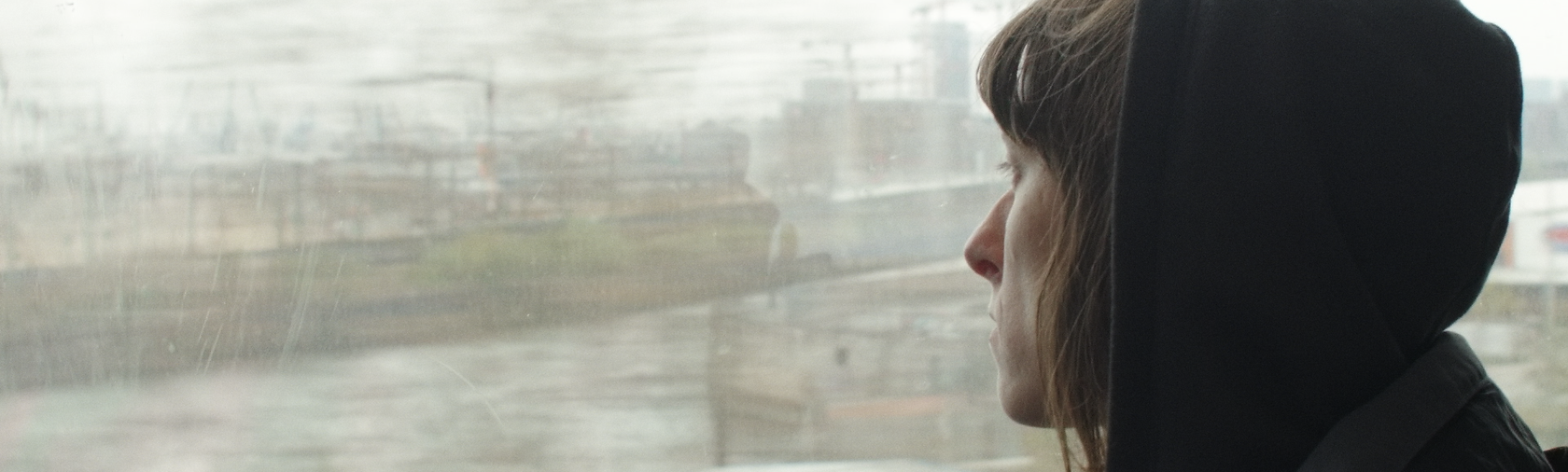
Still from Drift (2017).
Conversation with Helena Wittmann
Led by J.J. MOORE
Helena Wittmann is a German filmmaker whose films Drift (2017), Human Flowers of Flesh (2023), Ada Kaleh (2018) blend narrative, experimental, and documentary traditions into poetic meditations on space, perception, and the sea. She visited the Contemporary Moving Image Practices class at Harvard on April 17, 2025 for a screening and conversation about her practice.
The following is an excerpt from a presentation and discussion during Wittmann’s class visit on April 17.
BEX OLUWATOYIN THOMPSON: All of your films feel like invitations to drift — spatially, emotionally, temporally. What first drew you to the sea as a setting and a character?
HELENA WITTMANN: Yeah, that’s true. I guess maybe to start, it’s important to say that I don’t usually begin with a specific idea, like, “I want to make a film — what could it be about?” That’s not how it works for me. I’m usually informed by what I experience — where I am, who I meet, the questions that arise in that moment.
Spaces have always been interesting to me. It sounds a bit abstract now, but I try to understand places through their surfaces — what they contain, what they reveal. For example, someone has arranged these tables in a room a certain way for a reason, and I find that meaningful.
So when I was facing the ocean, the question that came up was, “What does this space mean?” We started researching in all different ways, always considering [the ocean] as a space — a political space, an aesthetic space, a historical space, and so on. What we then found was that there was a missing part: How do we perceive it? How do we feel being with the ocean?
Even when I talk to seafarers or [read] books, the ocean was always translated to a metaphor. It was often used to represent other things — blood, sound, waves, you know? It rarely stood on its own terms. That missing part — how we actually experience the sea — really started to interest us.
I say “us” because I was working with Theresa, who appears in Drift [1] — she’s acting in it, but she’s also an anthropologist. From the beginning, we knew we had to expose ourselves to the ocean in order to understand it, using all our senses as tools, as receptors, trying to get away from what we seem to “know” already. This is always also a big motto: Trying to shift perspectives and not trust certainties, concepts, discourses. I read them, I take them in, but then I want to question them, look at everything anew.
Drifting, usually you have a direction. I mean, you can use it in many terms. But if you read it for navigation, for example, it’s usually this phenomenon in which you have a goal — where you want to go — but then the currents shift your way all the time, which is something quite uncontrolled. But then you can, of course, go against it.
There’s a certain instability to it, which I talked a lot about. Usually, instability is frightening to most of us. But for me, it’s really reassuring, to go somewhere unstable. It allows me to stay open, to remain attentive.

Still from Drift (2017).
TEGA AJISE: I really liked what you said about providing the ocean with a voice and how it’s our ocean. Do you feel like this shift, this ebb and flow, is engaging in dialogue with the ocean? Who is involved in the dialogue? Is it us, the humans on the vessel with the ocean? Or do you think there is another type of dialogue happening there?
WITTMANN: First, what I learned being out on the sea, is that you have to accept it. There’s no forcing onto it, or else you stand no chance. Once you accept certain movements and states, it can then become very rich. I don’t want to sound esoteric here, but it’s very rich. There is something that is really really special that I have never experienced anywhere else. I still guard it, I have it with me when I go to the coast and enter the ocean now. I have this memory.
There is a question, which I can’t answer — I’d probably never answer — which is: How much memory does it really carry? Somehow, it’s a matter or medium and I don’t know how to understand it.
Some other way that I was thinking of framing the question was, whether the ocean itself has an independent presence?
AJISE: I couldn’t help but notice, especially in Drift, the sound editing and how tactile I felt the water was. The sound editing felt very textured. I was wondering, during that process, what went behind the sound editing? As well as how much of the audio was diegetic versus non-diegetic?
WITTMANN: This brings up another very important person in my filmmaking: Nika Son. We’ve been working together for sixteen years. She’s an artist and musician — she started in painting but drifted into sound. Her background is musique concrète and experimental electronic music. It’s great!
There’s something so close between us. Also, again, it is so amazing to find these people who you are in tune with. I think it has to do with sensibilities? Probably. This definitely goes for Nika and me. As for her, she can see my ideas and images so clearly to find the sound.
In all the films, it is super composed, even the scenes that don’t have music are completely composed. So, there is very little original sound. There is, sometimes, when there is dialogue, but then it is layered. And when we talk about the sea, when you record the sea it’s usually just white noise. It’s not very interesting. In order to get it [to sound] the way we perceive it, we have to rework it. Sometimes it’s a combination of different waves. Sometimes she’d give single waves a sound. It’s very subtle because we often try not to be intrusive with the sound, in the sense that it is in the foreground, always working on the relation between the sound and image in the way that each has its own space and can highlight or shift the other. In a good sense. We are both quite minimalistic. Usually we start with a lot and then reduce, reduce, reduce, reduce. With image, with sound, that’s the way it goes usually.
We started off very naive, we thought we could record the ocean on its own. But it’s impossible. But it’s also amazing that there is no sound recording of the ocean without the human being in it, existing. You always hear the waves against the boat, for example. It’s really loud, actually. And you can’t place the microphone just out there. It’s just not possible. It doesn’t exist. So what will we do?
Nika also does the sound recording on set and usually brings many different microphones on set. The boat — it’s incredible — is like a resonant body, you get that clearly in Human Flowers of Flesh.[2] We had contact microphones, we had hydrophones, it is interesting along the coastlines, but recordings with the hydrophones in the open ocean sounds like a toilet flush.
And then when it came to editing and thinking about the sound, we realized Okay, let’s not pretend to be objective with sound. It’s not the ocean, it’s our ocean. So if we give it a voice or a sound, let’s do it interpretively. That’s why at one point it gets synthetic. It’s only synthetic in Drift from one point on. It’s all about the composition. It starts, still, with highly concrete sounds…then transitions…and moves back again. It’s a shift.
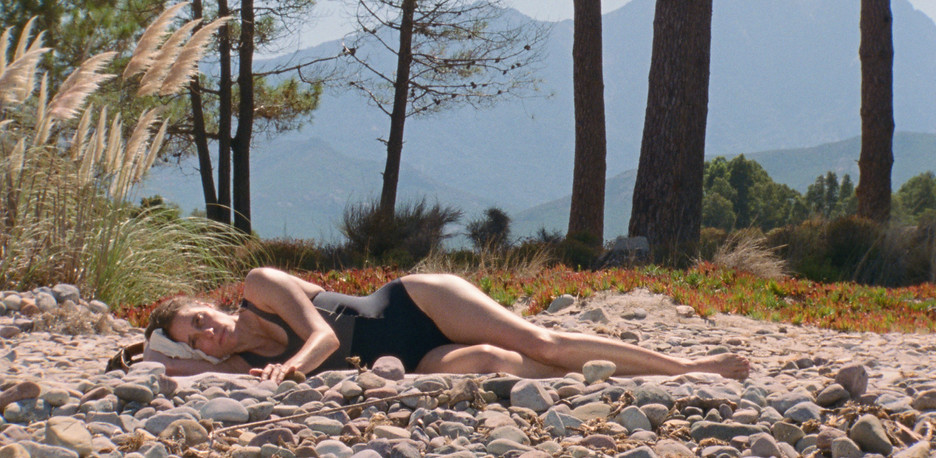
Still from Human Flowers of Flesh (2022).
J.J. MOORE: Do you feel like your reason for making Drift — your “why” — has changed since you first started it? Or has it stayed the same?
WITTMANN: The films I make are super entangled with my life. Always. Even if they’re not autobiographical. It’s not about me, but it’s about how I am in this world — or my attempt to relate to this world, to understand it, or explore it with curiosity and, hopefully, with tenderness.
With Drift, we shot over three years, in blocks, and I would edit in between. It developed very slowly and organically. With Human Flowers of Flesh, I approached it differently. But then again, I directed, did the cinematography, and edited myself. The film transforms and develops with every step, it never stays the same over the process of its becoming. I am not interested in following and realising an idea. Usually, there are many many questions that remain or come up. This would then inspire the next step or the next film. In Drift, we stay on the surface, we never go underwater. Of course, the depth was a question. I didn’t want to make an underwater film. But, what does it mean to trespass this surface? What lies underneath?
There’s only one dolphin that’s in the film, that we called “the messenger from the deep.” There were of course many animals that we filmed, but I decided we would only take one in the edit. It felt concentrated.
In Human Flowers of Flesh we then go underwater. It is like continuing the thoughts from one film to the next.
MOORE: You were talking about how you do your own cinematography. I noticed you’ve used different formats — 16mm film for Human Flowers of Flesh and it was digital for Drift. You were also using cyanotypes in Human Flowers of Flesh. What guides your decisions about which medium to use? How does the material process shape the image or atmosphere you’re trying to create?
WITTMANN: It’s a good question, it’s a combination of decisions usually. For Drift, I would have loved to shoot it on film in the beginning, but there was no money. I’m not dogmatic, so I shot it on a Blackmagic Pocket camera. I still love this camera.
Then I realized, throughout the process, that it was really good that we shot it digitally. This film took shape along the way. I could try many things, especially while shooting on the sea. I am not someone who shoots extensively — even digitally, I make decisions. But the flexibility allowed me to discover more and learn in the shooting process.
I wouldn’t have been able to write Human Flowers of Flesh without having this experience of learning to make a film on the go, understanding how it works — how stretching a feature film works. Before Drift, I’d only done short films and it’s very different.
For Human Flowers of Flesh, it was clear that I needed to shoot on film. I was interested in the matter of the sea, the microscopic images, and so on. What the sea actually contains — its substance. So I thought, filming it needs to be a chemical process, it’s not language-based like digital is.
But, I knew that at some point there would be lots of night shots. Nowadays, you can’t get very sensitive film material, it’s a problem. The other option was to have a track of lights. But I wanted to go on with how I’m shooting. I had to compromise, and decided to shoot the night with a digital camera. I’m really happy about that. It kept the dynamic of shooting as intimate as it was. Film is very good in daylight and digital is very good at night. Why not use both? It just depends a little.
And for the cyanotypes — this was crazy. I had the idea when I first started doing my research. This quality, just from the color alone, amazed me. You only use sunlight to expose and water to develop which, again, seems so connected [to the sea] and very very simple.
The problem was that applying cyanotype to film wasn’t easy, as it is a liquid. I needed to experiment with gelatine and other components until I found the way to do it. It took me one year to do. I had to transfer the chemicals onto blank film, frame by frame. When I had good results for the first time, I was like, Oh my god! I can see something!
AJISE: One question that I wanted to ask was calling back to what you said about a lot of the films that you made being based on personal experience and just recounting your life — not necessarily in an autobiographical way? What do you think was one of the hardest things that you wanted to express or capture that you were able to or maybe had challenges with doing in some of the films that you created?
WITTMANN: There are many. Sometimes, there are things that I just can’t do. For example, the underwater shot in Human Flowers of Flesh, it was 40 meters deep. I couldn’t do that myself, so I had to ask someone else to do it for me.
When I wrote Human Flowers of Flesh, I never would have thought that I could enter the French Foreign Legion, because it is very secretive. And there are no women. And suddenly there were two coincidences which opened the doors. We took the opportunity. It was uncomfortable at first, because, do I really want to go there? But it would have been shallow not to go there and to pretend to make a film with the Legion appearing as a subject. I had to go there. And I learned so much.
One thing that — until today — I’d found super sad was that this last part — which is Algeria— is not shot in Algeria because I couldn’t get a Visa. In the end, I got a Visa but there were no flights because it was the pandemic. It was a bit difficult. So it was the first time in my life where I couldn’t enter a country, which was, of course, frustrating; but then, again — like we talked about — limitations. This was the experience that most humans have in this world, probably like 85% have no access. I have this German passport which allows me to go anywhere, usually. Maybe it’s good to have this experience: Not being able to enter. I felt really humbled.
And for me it was not existential, as it is for many persons. It was just in order to film. It was hard to accept that I needed to find another place to shoot this part. At first I thought, do I have to change the script, but it wasn’t possible at that stage. I tried for one year to get into Algeria because I didn’t want to shoot elsewhere, then it was clear that it wouldn't happen. I think now it would be possible. I’d be curious to go there one day.
But thanks to political reasons and the pandemic combined it was impossible. So we shot the final part in Morocco. I learned other things, and some might appear in future works.
REFERENCES
[1] Wittmann, Helena, dir. Drift (2017).
[2] Wittmann, Helena, dir. Human Flowers of Flesh (2023).
[3] Wittmann, Helena, dir. Ada Kaleh (2018).